Search Articles

Find Attorneys

A New Push to Put Homeless Veterans Under Legal Guardianship

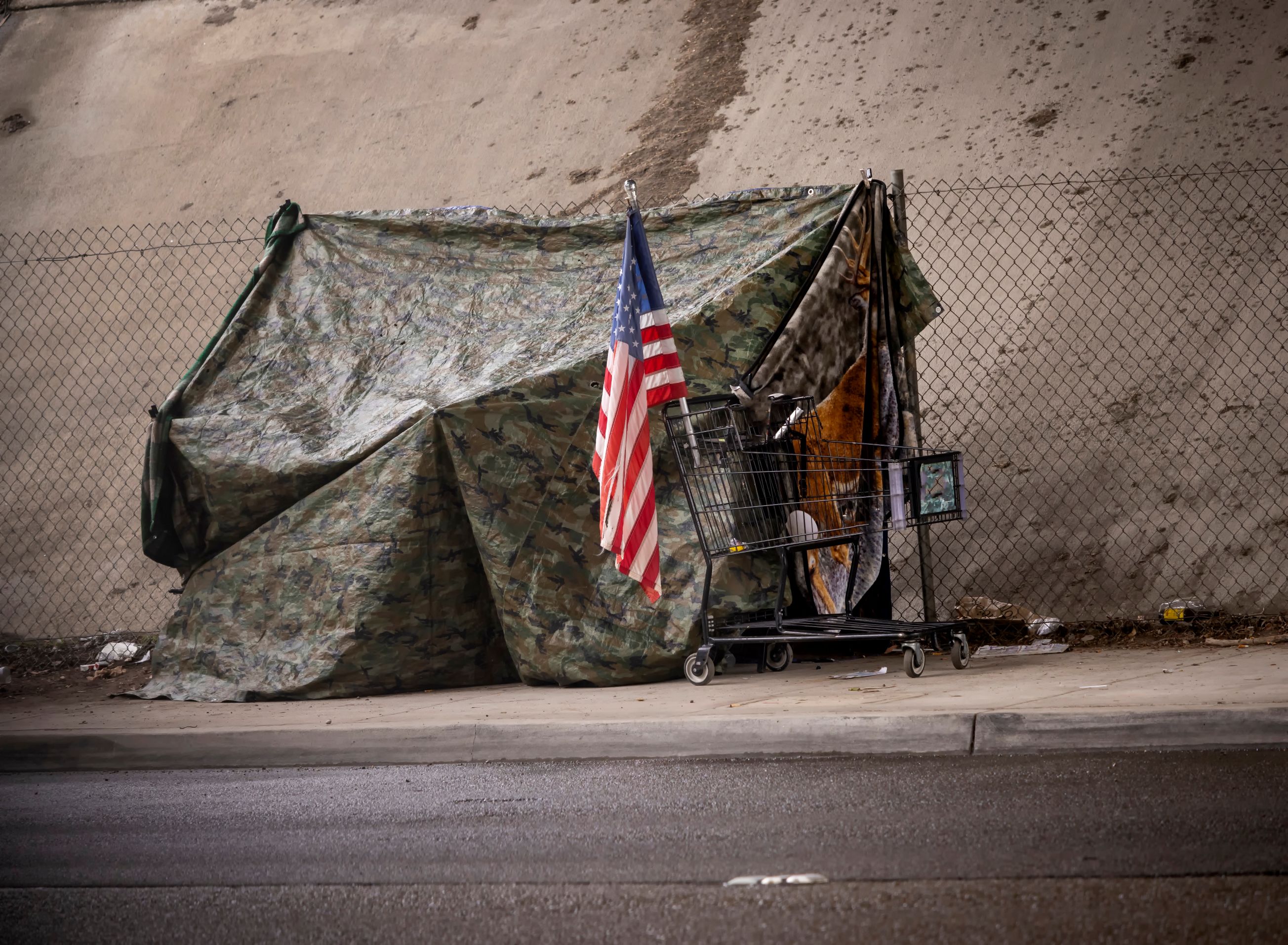
An American flag at a homeless tent made of camouflage tarp at a road underpass.Takeaways

  • A new federal agreement allows government attorneys to seek legal guardianship over homeless veterans, or those at risk of homelessness, who are deemed unable to make their own health care decisions.
  • Supporters argue this policy is a necessary lifeline to move incapacitated veterans out of hospital limbo, while critics warn it is a serious threat to the veterans civil liberties and autonomy.

A new federal policy raises urgent questions about care, autonomy, and what it means to serve those who have served. Earlier this month, the Trump administration announced a significant action targeting homeless veterans in the form of a formal agreement between the Department of Veterans Affairs (VA) and the Department of Justice (DOJ). The policy gives VA attorneys new legal power to pursue guardianship over veterans who are homeless or at risk of becoming homeless.

The policy has drawn praise from some quarters as a compassionate lifeline for the most vulnerable veterans. Others are calling it a threat to civil liberties that could strip men and women who served their country of their fundamental right to make decisions for themselves.

Local Elder Law Attorneys in Your City

Elder Law Attorney

Firm Name
City, State

Elder Law Attorney

Firm Name
City, State

Elder Law Attorney

Firm Name
City, State

What exactly is happening and what does it mean?

What the Policy Does

The new initiative gives the DOJ authority to appoint VA lawyers as special assistant U.S. attorneys, allowing them to initiate and participate in state court guardianship cases or conservatorship proceedings. In plain terms, government attorneys can now go to court to ask a judge to appoint a legal guardian – often when a qualified family member is unavailable – over a veteran who is deemed unable to make their own health care decisions.

The stated goal is to help veterans who are stuck in a kind of bureaucratic purgatory. Without a legal decision-maker, some veterans become trapped in limbo. That is, they may be medically stable, but unable to leave a hospital because no one can legally authorize a discharge plan or placement in long-term care. The administration argues that guardianship can break that cycle.

VA officials say the move is intended to help veterans transition from prolonged hospital stays to appropriate care settings. A VA news release states that “the appointment of a legal guardian or conservator can be a lifeline for veterans in this situation.”

Who Could Be Affected by This New Policy

Nearly 33,000 veterans are experiencing homelessness in the U.S. Almost 14,000 of them live on the streets, according to a 2024 report from the Department of Housing and Urban Development (HUD).

The VA said in a statement that the agency serves hundreds of veterans who cannot make their own health care decisions and don’t have family or legal representation, including those experiencing homelessness. VA press secretary Peter Kasperowicz has emphasized that the policy is not aimed at homeless veterans broadly, but rather at roughly 700 veterans currently in VA facilities who lack the capacity to make decisions for themselves and who don’t have anyone to make legal decisions for them.

Half of the nation’s homeless veterans have a mental illness, and 70 percent struggle with substance use disorders. These conditions can sometimes impair a person’s ability to advocate for their own care.

Why Critics Are Alarmed

While supporters frame this policy as a compassionate intervention, civil rights and advocacy groups are raising serious concerns.

Unlike a civil commitment, which has an expiration date, guardianships are designed to be permanent. These arrangements can be revisited periodically, but the burden falls on the ward (in this case, the veteran) to prove they should get their autonomy back.

Jennifer Mathis, the deputy director at the Bazelon Center for Mental Health Law, questioned whether guardianship is the right solution. She said that if veterans are in VA hospitals and not discharged, it’s likely because there aren’t enough services or housing for them, not because they don’t have guardians to make decisions for them.

The National Coalition for Homeless Veterans warned that “guardianship and other forms of involuntary intervention are serious legal actions that remove significant personal autonomy. They must be used sparingly, with strong safeguards, and always with the best interests and rights of the veteran at the center of the process.”

Veterans’ advocates also say that the phrase “at risk of homelessness” is vague and undefined in the agreement. They worry the definition could expand, such as applying to a veteran behind on rent or others in precarious but not incapacitated situations.

What Supporters Say

Not everyone opposes the initiative. Michael Figlioli, director of the National Veterans Service for the Veterans of Foreign Wars, applauded the move, telling Newsweek that “some of our nation’s most vulnerable veterans must be approached through a public health and social services framework,” and that guardianships can provide “structured support” for vulnerable veterans.

Stephen Eide, a homelessness expert at the Manhattan Institute, argued in the same Newsweek piece that for some veterans with severe untreated conditions like schizophrenia, “the choices are either no treatment or some kind of involuntary treatment.” He did, however, acknowledge that executing such a policy at the federal level “will require a lot of coordination between police, social workers, state, and local governments.”

What Comes Next

The policy’s real-world effects will depend heavily on how the guardianship powers are used, as well as oversight and accountability of the guardians. Veterans who are deemed in need of a guardian may benefit from being able to choose their guardian.

For now, the agreement is in effect. Veterans’ rights organizations, legal advocates, and members of Congress will likely be watching closely. Veterans themselves will need clear information about this policy, what it means for them, and what resources are available to protect their well-being and autonomy.

Resources for Veterans Experiencing Homelessness

If you are a veteran who is homeless or at imminent risk of homelessness, help is available 24 hours a day, seven days a week: Call the National Call Center for Homeless Veterans at (877) 4AID-VET (877-424-3838).

Here are other key organizations and programs:

Housing Assistance Programs

  • HUD-Veterans Affairs Supportive Housing (HUD-VASH). This program combines HUD’s Housing Choice Voucher rental assistance for homeless veterans with case management and clinical services provided by the VA. Contact your nearest VA medical center and ask about HUD-VASH.
  • Supportive Services for Veteran Families (SSVF). Through referrals and direct outreach, nonprofit agencies use SSVF funding to quickly house veterans and their families who are homeless and to keep others from slipping into homelessness by providing supportive services that promote housing stability.
  • VA Grant and Per Diem Program. State, local, and tribal governments and nonprofits receive funding to develop and operate transitional housing for veterans who are homeless, with a maximum stay of up to 24 months and a goal of moving veterans into permanent housing.
  • Disabled Veterans National Foundation – Homeless to Housing (H2H). This program provides up to $2,000 to cover essential costs related to securing permanent housing, such as security deposits and initial rent payments, as well as up to $2,000 worth of essential household items.

Mental Health and Crisis Support

Legal Help

  • Bazelon Center for Mental Health Law. The Bazelon Center advocates for the rights of people with mental disabilities.
  • National Homelessness Law Center. NHLC provides legal resources and advocacy for people experiencing homelessness.

Find Local Help

You can also call or visit your local VA Medical Center or Community Resource and Referral Center, where VA staff are ready to help. Use the VA locator tool at va.gov/directory to find the nearest location.

Every veteran deserves a home, health care, and the dignity of making their own choices. If you or someone you know is at risk, please know that help is available.

Additional Reading

For additional reading on topics relevant to veterans, check out the following articles:


Created date: 03/26/2026
Medicaid 101
What Medicaid Covers

In addition to nursing home care, Medicaid may cover home care and some care in an assisted living facility. Coverage in your state may depend on waivers of federal rules.

READ MORE
How to Qualify for Medicaid

To be eligible for Medicaid long-term care, recipients must have limited incomes and no more than $2,000 (in most states). Special rules apply for the home and other assets.

READ MORE
Medicaid’s Protections for Spouses

Spouses of Medicaid nursing home residents have special protections to keep them from becoming impoverished.

READ MORE
What Medicaid Covers

In addition to nursing home care, Medicaid may cover home care and some care in an assisted living facility. Coverage in your state may depend on waivers of federal rules.

READ MORE
How to Qualify for Medicaid

To be eligible for Medicaid long-term care, recipients must have limited incomes and no more than $2,000 (in most states). Special rules apply for the home and other assets.

READ MORE
Medicaid’s Protections for Spouses

Spouses of Medicaid nursing home residents have special protections to keep them from becoming impoverished.

READ MORE
Medicaid Planning Strategies

Careful planning for potentially devastating long-term care costs can help protect your estate, whether for your spouse or for your children.

READ MORE
Estate Recovery: Can Medicaid Take My House After I’m Gone?

If steps aren't taken to protect the Medicaid recipient's house from the state’s attempts to recover benefits paid, the house may need to be sold.

READ MORE
Help Qualifying and Paying for Medicaid, Or Avoiding Nursing Home Care

There are ways to handle excess income or assets and still qualify for Medicaid long-term care, and programs that deliver care at home rather than in a nursing home.

READ MORE
Are Adult Children Responsible for Their Parents’ Care?

Most states have laws on the books making adult children responsible if their parents can't afford to take care of themselves.

READ MORE
Applying for Medicaid

Applying for Medicaid is a highly technical and complex process, and bad advice can actually make it more difficult to qualify for benefits.

READ MORE
Alternatives to Medicaid

Medicare's coverage of nursing home care is quite limited. For those who can afford it and who can qualify for coverage, long-term care insurance is the best alternative to Medicaid.

READ MORE
ElderLaw 101
Estate Planning

Distinguish the key concepts in estate planning, including the will, the trust, probate, the power of attorney, and how to avoid estate taxes.

READ MORE
Grandchildren

Learn about grandparents’ visitation rights and how to avoid tax and public benefit issues when making gifts to grandchildren.

READ MORE
Guardianship/Conservatorship

Understand when and how a court appoints a guardian or conservator for an adult who becomes incapacitated, and how to avoid guardianship.

READ MORE
Health Care Decisions

We need to plan for the possibility that we will become unable to make our own medical decisions. This may take the form of a health care proxy, a medical directive, a living will, or a combination of these.

READ MORE
Estate Planning

Distinguish the key concepts in estate planning, including the will, the trust, probate, the power of attorney, and how to avoid estate taxes.

READ MORE
Grandchildren

Learn about grandparents’ visitation rights and how to avoid tax and public benefit issues when making gifts to grandchildren.

READ MORE
Guardianship/Conservatorship

Understand when and how a court appoints a guardian or conservator for an adult who becomes incapacitated, and how to avoid guardianship.

READ MORE
Health Care Decisions

We need to plan for the possibility that we will become unable to make our own medical decisions. This may take the form of a health care proxy, a medical directive, a living will, or a combination of these.

READ MORE
Long-Term Care Insurance

Understand the ins and outs of insurance to cover the high cost of nursing home care, including when to buy it, how much to buy, and which spouse should get the coverage.

READ MORE
Medicare

Learn who qualifies for Medicare, what the program covers, all about Medicare Advantage, and how to supplement Medicare’s coverage.

READ MORE
Retirement Planning

We explain the five phases of retirement planning, the difference between a 401(k) and an IRA, types of investments, asset diversification, the required minimum distribution rules, and more.

READ MORE
Senior Living

Find out how to choose a nursing home or assisted living facility, when to fight a discharge, the rights of nursing home residents, all about reverse mortgages, and more.

READ MORE
Social Security

Get a solid grounding in Social Security, including who is eligible, how to apply, spousal benefits, the taxation of benefits, how work affects payments, and SSDI and SSI.

READ MORE
Special Needs Planning

Learn how a special needs trust can preserve assets for a person with disabilities without jeopardizing Medicaid and SSI, and how to plan for when caregivers are gone.

READ MORE
Veterans Benefits

Explore benefits for older veterans, including the VA’s disability pension benefit, aid and attendance, and long-term care coverage for veterans and surviving spouses.

READ MORE